ZnCuAgPbAuW
Abril Mine
Historic zinc–copper–silver skarn property with gold occurrences · Dragoon / Middle Pass Mining District
Project Overview
The Abril Mine is a historic zinc–copper–silver skarn property in Cochise County, Arizona, associated with the Stronghold batholith contact. Historical records document approximately 30,794 dry tons of production — principally from zinc-bearing skarn — across multiple operators including Shattuck-Denn Mining Corporation. The mine contains five historic levels, multiple adits, drifts, crosscuts, raises, winzes and stopes. The 1993 Bureau of Mines appraisal summarized historic output at approximately 8 million pounds of zinc, 0.4 million pounds of copper, and potentially up to 50,000 ounces of silver. Selected samples include individual elevated gold, silver, copper, and zinc values, though one GRMP report section states surveyors took no assay samples — creating a provenance contradiction that requires resolution. Tungsten occurs regionally in the Dragoon district (huebnerite and scheelite) but property-specific tungsten continuity has not been demonstrated.
Strategy & Development Path
Current work priorities: recover the complete 2018–2024 JV data package, digitize historical workings and production records, reconcile sample IDs and assay certificates, build a skarn-domain model, and resample accessible workings with tungsten included in the analytical suite.
Geological Context
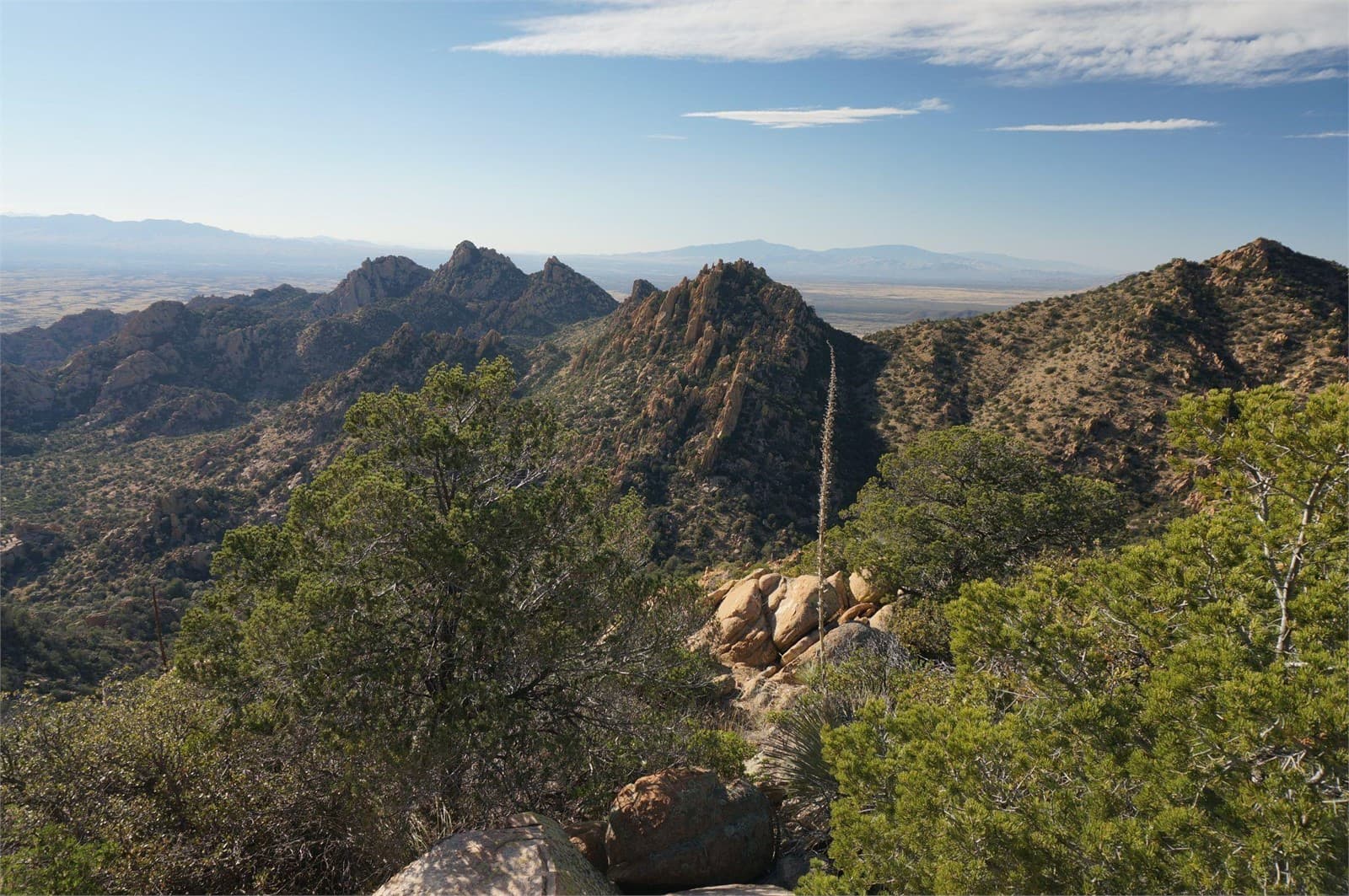
Abril lies in the northwestern Dragoon Mountains near the Stronghold batholith. The 1993 Bureau of Mines account describes skarn hosted near the base of a thick Naco Group limestone bed, with the Stronghold batholith within approximately 100 feet of the host limestone and quartzite in part of the intervening section. Two skarn bodies are identified: a lower skarn (strike ~N20°W, dip ~45° NE, average width ~15 ft, local widths to ~30 ft) that supplied essentially all historical production, and an upper skarn approximately 100 feet above, described as lower grade and less continuous. Mineralized strike lengths of 50–150 feet are reported on various levels. The geometry describes discrete skarn bodies or lenses, not one continuous sheet of uniform mineralization. The broader Dragoon/Texas Canyon region contains documented huebnerite and scheelite occurrences — typically small, discontinuous veins — providing regional tungsten context rather than property-specific tungsten proof.
What We Know
Historical production (zinc)Historical Government Record
Approximately 30,794 dry tons — principal historic commodity with substantial operator documentation
Source: DMEA, Bureau of Mines 1993 appraisal
Historical production (copper/silver)Historical Government Record
Approximately 0.4 million lbs Cu; potentially ~50,000 oz Ag — minor gold production also reported
Source: Bureau of Mines 1993 appraisal
GRMP assay contradictionHistorical Third-Party Report
One report section lists 3 results including 2.69 oz/t Au underground sample; another states no assay samples were taken — requires reconciliation
Source: Abril GRMP-43 Report
Regional tungstenHistorical Government Record
Huebnerite and scheelite documented in the Dragoon/Texas Canyon district; regional veins often small and discontinuous
Claim serialsVerified Official Record
2 active serials (40 acres) recorded with BLM — formal claim description confirms two 20-acre lode claims
Technical Notes & Disclosures
Historical production, assay, tonnage, mineralization, appraisal, and development references are drawn from records of varying age, provenance, and technical quality. Unless explicitly identified as current independent work, they have not been verified by Sovereign Resource Holdings or a Qualified Person and should not be interpreted as a current mineral resource, mineral reserve, economic project, recoverable inventory, or property valuation.
Source discrepancies being reconciled:
- GRMP report: one section references 43 samples with 3 results; another section states no assay samples were taken
- Acreage: formal claim description states 40 acres; one report section references 60 acres
- Earlier summaries describe ~31,000 ft of workings — source context supports ~31,000 tons of production, not linear footage
- Historic zinc operation vs. earlier promotional gold-primary positioning
- Regional tungsten evidence (Dragoon district) vs. property-specific tungsten evidence (not yet demonstrated)
Unresolved technical questions:
- Provenance of reported gold assays — laboratory certificates, chain of custody, sample IDs not confirmed
- Remaining zinc and copper resource potential in the upper skarn body
- Whether tungsten occurs in economically significant concentrations within the 40-acre claim
- Current water conditions in lower workings and dewatering requirements